Telehealth auditory processing care, from home
When listening is hard, even with “normal” hearing
NeuraListen™ is a telehealth program that evaluates how your brain processes sound and offers targeted treatment—so conversations, classrooms, and daily life feel calmer and less exhausting.
Comprehensive auditory processing evaluations for children and adults — $495 | 90 minutes
No referral required • Available in select states
Looking for information for clinicians? View clinician information here.
“I can hear, I just can’t keep up.”
If this sounds like you or your child, you are not imagining it—and you are not alone. Auditory processing challenges are common, often missed, and very real.
NeuraListen brings gold-standard auditory processing evaluation and treatment into your home through secure telehealth sessions.
You are not “too sensitive”
Listening shouldn’t leave you drained
Many people are told their hearing is “normal,” yet they still struggle to follow conversations, especially in noise or fast speech. This can feel frustrating, confusing, and isolating.
If you are constantly saying “what?”, avoiding phone calls, dreading meetings, or worrying about your child falling behind, your experience is valid. There may be a brain-based reason—and there is something we can do about it.
- You hear the sounds, but speech feels “muddy” or too fast.
- Background noise makes it almost impossible to catch words.
- You feel mentally exhausted after listening or social events.
- Your child is bright, but struggles to follow multi-step directions.
- Teachers say your child “doesn’t listen,” but you sense something deeper.
These are common signs of auditory processing differences—not character flaws, not laziness, and not a failure on your part as a parent.
Is NeuraListen right for you?
Who this is for—and not for
Setting clear expectations helps you decide if this program matches your needs, before you commit time or resources.
NeuraListen is a good fit if:
You (or your child) have normal or near-normal hearing, but listening is still hard.
You notice extra difficulty in noisy places, group conversations, or rapid speech.
You’re seeking an explanation that goes beyond “try harder to focus.”
You are open to telehealth sessions and have a quiet space with reliable internet.
You want both strategies for today and the possibility of improving underlying skills.
NeuraListen is not the right first step if:
- There is suspected or known significant hearing loss that has not been medically evaluated.
- You are in immediate crisis or need emergency mental health support.
- Reliable internet or a reasonably quiet space for sessions is not available.
- You are seeking a quick “fix” without time for practice or collaboration.
- You are outside of the states where our clinicians are currently licensed.
Not sure if auditory processing may be contributing?
Many people experience listening difficulties without knowing whether auditory processing is part of the picture.
To help clarify whether a comprehensive auditory processing evaluation may be appropriate, we offer a brief screening tool based on common listening experiences.
This screener is not diagnostic, but it can provide helpful insight and guide next steps.
Understanding auditory processing
Hearing is the ears. Understanding is the brain.
Standard hearing tests measure how well your ears detect sound. Auditory processing looks at what happens next—how your brain organizes, filters, and makes sense of those sounds in real time.
What is auditory processing?
Auditory processing is the set of brain skills that allow you to notice, focus on, and interpret sound. It helps you separate a friend’s voice from background noise, remember verbal instructions, and keep up with rapid speech.
What happens when it’s hard?
When auditory processing is inefficient, the brain has to work much harder to decode speech. You may miss parts of words, lose track of conversation, or feel overloaded by noise—even though your hearing test is normal.
Why it’s often missed
Auditory processing differences can look like inattention, anxiety, or learning challenges. Without specific testing, they’re easy to overlook—which is why many adults and children reach us after years of feeling misunderstood.
Short, plain-language education
Watch these 2–4 minute videos to get oriented
Each Loom video below walks through one piece of the puzzle. You can watch them in any order, pause as needed, and share them with family members or teachers.
Prefer to read instead of watch? The key ideas are also summarized on this page. The videos simply give you another way to hear the information in a calm, guided format.
You do not need to watch everything before booking. They are here to help you feel informed and prepared.
1. What is auditory processing?
A gentle overview of how the brain processes sound, why traditional hearing tests may miss important pieces, and common everyday signs of auditory processing differences.
2. How NeuraListen evaluates auditory processing
Walk through what happens in an online auditory processing evaluation, what you’ll see on your screen, and how we keep the experience structured and supportive.
3. Treatment: what sessions actually look like
See examples of telehealth treatment activities, how we tailor difficulty levels, and how progress is monitored over time.
4. Supporting school, work, and home
Practical ways we collaborate on classroom accommodations, workplace strategies, and home routines so listening feels more manageable day to day.
How NeuraListen works
A clear path from “something feels off” to a personalized plan
Everything is done over secure video, at home. We pace sessions thoughtfully and explain each step so you and your child know what to expect.
Our telehealth platform is HIPAA-compliant, and all clinicians are licensed audiologists with specialized training in auditory processing evaluation and rehabilitation.
Step 1
Brief intake & screening
You complete a short online questionnaire about listening situations, school or work demands, and any diagnoses. We review this to confirm that a NeuraListen evaluation is likely to be a good fit.
Step 2
Comprehensive telehealth evaluation
Across one or two online sessions, we use standardized auditory processing tests and real-world listening tasks. We look at skills like hearing in noise, rapid speech, pattern recognition, and working memory for sound.
Step 3
Calm, clear feedback session
We meet with you (and, when appropriate, your child) to review results in plain language. You’ll see where listening is strong, where it is working harder, and what that means for everyday life and learning.
Step 4
Personalized treatment plan
If treatment is appropriate, we design a structured program of telehealth sessions, at-home practice, and practical accommodations for school, work, and home environments.
Step 5
Ongoing support & re-evaluation
We check in regularly on progress, adjust activities, and, when helpful, re-test specific skills. We can also share reports with your care team and educators with your permission.
Clinical expertise, human approach
Care that is evidence-based, thoughtful, and genuinely human
NeuraListen was built by audiologists who repeatedly saw individuals told, “your hearing is normal,” even when listening, learning, and communication still felt effortful, overwhelming, or exhausting.
Our evaluations and treatment plans follow evidence-informed protocols, while always centering your lived experience and goals.
Our clinical standards
Evaluations conducted by licensed audiologists with APD expertise.
Use of validated auditory processing test batteries, adapted for telehealth.
Written reports you can share with physicians, schools, and other providers.
Collaboration with your existing care team when you choose to involve them.
“For the first time, our daughter felt like someone fully understood what listening is like for her. The report and recommendations changed how her teachers support her in class.”
- Parent of a 10-year old NeuraListen client
Licensing & privacy
NeuraListen operates within state licensure requirements. Sessions are delivered over encrypted, HIPAA-compliant video platforms. We do not share your information without your written permission, except where required by law.
Collaborative by design
We regularly coordinate with speech-language pathologists, psychologists, educators, and primary care providers. Our goal is to add clarity and support—not to replace the rest of your care team.
Transparent next steps
If we believe another service or specialist would better meet your needs, we will say so clearly and help you understand why. Our recommendation will always prioritize your wellbeing, not our caseload.

Auditory Processing Evaluation
$495 | 90-minute telehealth session
This is a comprehensive auditory processing evaluation conducted one-on-one by a licensed audiologist using evidence-based test protocols adapted for virtual care.
The session emphasizes clarity, depth, and individualized attention to each patient’s needs.
Comprehensive case history and intake review
Age-appropriate auditory processing test battery
Expert interpretation by an APD-trained audiologist
Written clinical report that can be shared with schools, physicians, or other providers
Clear, personalized next-step recommendations (with no obligation)
When clinically appropriate, structured 12-week auditory training programs are typically $1,995 and are discussed only after evaluation.
NeuraListen is a private-pay service. We do not bill insurance, but many families choose to submit our reports for potential out-of-network reimbursement.
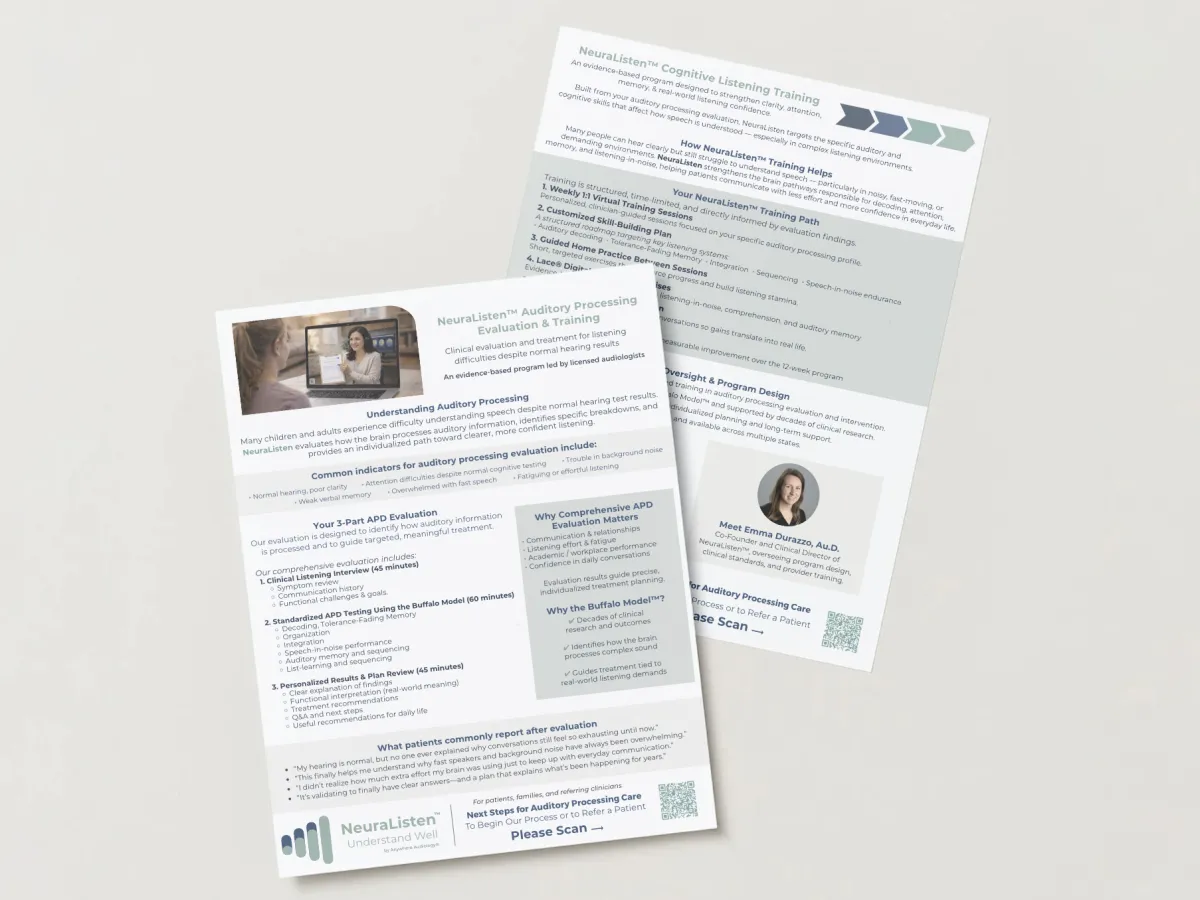
NeuraListen™Auditory Processing Evaluation & Training Overview
A concise clinical overview outlining the evaluation process and structure of the NeuraListen™ telehealth program.
Ready for listening to feel less overwhelming?
Two simple ways to move forward.
You can either book a full auditory processing evaluation online, or request a brief call to discuss whether NeuraListen is a good next step.
There is no pressure to decide quickly. Our role is to offer clear information and options so you can move at a pace that feels right.
Typical evaluation includes:
60–120 minutes of structured testing (may be split across sessions).
A feedback visit to walk through results and recommendations.
A written summary you can refer back to and share as needed.
Pricing and insurance details are provided before you confirm your appointment.
Option 1: Book an evaluation online
Choose a time that works for you, complete a short intake form, and receive confirmation with all details for your telehealth visit.
You can reschedule or cancel within our clear, written policy window.
Option 2: Request a call
Share a few details about your situation and we’ll reach out for a brief, no-pressure call to help you decide on next steps.
If NeuraListen isn’t the right fit, we’ll suggest alternative resources when possible.
If you’re not ready yet, you are still welcome to return to this page and share it with those who support you.